female-medic-measuring-blood-pressure-pulse-patient.jpg

Retain a Vibrant Life with Proactive Physiology Services

Define your health journey: discover the usefulness of “gold standard” non-invasive clinical physiology services and innovative technologies to help you take control of aging and embrace a vibrant, independent lifestyle

Pricing appears after you choose a time + no payment required to book.

〰️

Pricing appears after you choose a time + no payment required to book. 〰️

Body Composition

Body Composition Analysis

    • What it is:Bio-impedance scan showing fat mass, muscle/lean mass, body water and phase angle (cell health marker).

    • Why it helps: Weight can be misleading; BCA confirms you’re losing fat while preserving muscle, especially important for older adults.

    • What to expect: Stand/lie still for a few minutes with small sensors. No radiation.

    • Prep (for best accuracy): Avoid large meals & heavy exercise 4–6 h prior; normal hydration; no alcohol 24-h; tell us if you have a pacemaker/ICD.

    • Report: Results summary + clinician PDF in 2–3 business days.

    Why it matters

    • Weight alone can mislead. You can lose kilos but mostly lose water or muscle.

    • Muscle mass is vital for strength, balance, and independence—especially for older adults.

    • Tracking composition helps tailor diet and exercise so you keep (or build) muscle while reducing excess fat.

    What we measure(non-invasive bio-impedance)

    • Fat mass and % body fat

    • Fat-free mass / skeletal muscle

    • Total body water (intra-/extra-cellular balance)

    • Phase angle (cell health marker)

    • Segmental distribution (where changes are happening)

    About our system
    We use an AKERN® bio-impedance analyser—an approach supported by decades of clinical research 4000 peer reviewed articles and use across hospitals and sports medicine in Europe. It’s quick, painless, and safe (no needles, no radiation).

    Scope & safety

    • BCA is a functional assessment, not a diagnosis. If we see unexpected findings, we’ll discuss them and advise GP follow-up where appropriate.

    • Duration:15–20 min

      • Setup: Multi-frequency BIA (AKERN®); stand/lie still with small sensors

      • Prep (best accuracy): Avoid large meals & heavy exercise 4–6 h; normal hydration; no alcohol 24-hr; no BIA with pacemaker/ICD

      • Comfort: Painless; no radiation

      • Outputs: Fat mass %, lean/muscle mass, water balance (ECW/ICW), phase angle, segmental distribution

      • Results: PDF in 2–3 business days

      • Follow-up: Compare at 4–8 weeks

      • Add-ons:Exercise prescription; nutrition referral

      • Reschedule: Free if >24-hr before

Test Info - Clinician Level
Bookings
Vascular Testing

Vascular Assessments

  • What is vascular testing?
    We use a non-invasive cuff and sensor to analyse how fast blood travels through your main arteries. This shows us how stiff or elastic your arteries are and estimates central (aortic) blood pressure—the pressure your heart actually pumps against.

    Why it matters
    As we age, arteries can become stiffer. Stiff arteries mean:

    • The heart must work harder to push blood forward.

    • Central blood pressure can rise even if arm-cuff BP looks “ok.”

    • Pulse pressure reaching delicate organs (e.g., kidneys, brain) can increase.
      Understanding this helps us tailor exercise intensity and blood-pressure goals, and gives you a baseline to track improvement.

    What we measure

    • Central (aortic) systolic/diastolic pressure

    • Pulse pressure and wave shape

    • Augmentation Index (AIx) — a marker of arterial stiffness and wave reflection

    • Resting and Exercised Pulse Wave Velocity (PWV) — speed of the pressure wave along the artery

    What the test is like

    • You’ll rest quietly while we place a standard BP cuff and a small sensor.

    • We record a short series of pulses—no needles, no injections.

    • The test takes about 10–15 minutes - resting and the same for an exercising measure.

    How we use the results

    • Check it’s safe to proceed with exercise testing and set starting intensities.

    • Identify people who may benefit from 24-hour BP monitoring (day/night pattern) or GP follow-up.

    • Re-test at follow-up to see whether exercise is improving vascular measures and reducing your risk of developing cardiovascular disease. - which the western worlds #1 killer.

    Safety & scope
    This is a functional assessment, not a complete diagnosis but it can form part of this process. If we see values that need medical review, we’ll pause and help you contact your GP/cardiologist.

    Good to know
    Not all blood-pressure cuffs report central pressure or AIx. Our system (SphygmoCor®) provides these extra measures to give a clearer picture of vascular load. This is the “gold standard” device used by health professionals globally. (2000 peer reviewed publications).

    Preparation

    • Avoid caffeine for 3 hours before your visit if you can.

    • Take prescribed medications as usual unless your doctor advises otherwise.

    • Wear a short-sleeved top.

    Add-ons

    • 24-hour BP + Central Haemodynamics (AIx) — ambulatory monitoring to see your day/night pattern and vascular load in real life.

  • Non-invasive central (aortic) BP and arterial stiffness (AIx) at rest -

    • Cuff + sensor only;

    • Good baseline for safe exercise prescription

    • Prep: avoid caffeine for 3 h; wear a short-sleeved top.

    • Report: clinician PDF in 2 –3 business days (priority 24-hr).

  • (45 min, 2 readings)

    • Resting measures plus a light step/walk/cycle to see response under gentle load

    • Estimates “active” stiffness and central BP

    • Prep: as above; wear comfortable shoes

    • Report: PDF in 2–3 business days
      Book: use the button below

Test Info - Clinician Level
Bookings
A sphygmomanometer and stethoscope on a patient's arm.

24-hr Ambulatory BP

  • What it is
    A small wearable monitor and cuff record your blood pressure throughout the day and night while you do normal activities and sleep. This shows your real-life blood pressure pattern, not just a one-off clinic reading.

    Why it matters

    • High blood pressure can strain pressure-sensitive organs like the heart and kidneys.

    • Some people have “normal” readings in clinic but higher at home (or the reverse).

    • Night-time readings (whether your BP “dips” in sleep) and the size of each pulse (pulse pressure) add important context for risk and treatment.

    • Our device also estimates central (aortic) pressure—the pressure your heart actually pumps against—which a simple arm cuff can’t provide.

    Our system
    We use the Oscar 2™ Ambulatory Blood Pressure Monitor with SphygmoCor® Inside. It combines standard 24-hour BP with central pressure and arterial waveform analysis to give a clearer picture of vascular load.

    What you’ll measure

    • Daytime and night-time systolic/diastolic BP

    • Average 24-hour BP and BP load (time spent above target)

    • Dipping pattern (how BP changes during sleep)

    • Pulse pressure and central (aortic) BP estimates

    • (Where applicable) Augmentation Index (AIx) as a marker of arterial stiffness

    What the process is like

    1. Fit & setup (15 min): We place a cuff and small recorder on a belt or shoulder strap.

    2. Go about your day: The cuff inflates automatically (typically every 20–30 min by day, less often overnight). We give you a short activity/sleep diary.

    3. Return next day: We remove the monitor and review the data with you.

    How the results help

    • Identify masked or white-coat hypertension

    • Check night-time control and “dipping” (important for heart/kidney health)

    • Tailor exercise intensity and discuss whether your medication timing/dose needs a GP review

    • Provide a baseline to compare at follow-up

    Comfort & safety

    • Expect brief squeezes from the cuff; your arm may feel tender after repeated inflations.

    • You can remove the cuff for showering (we’ll show you how) and refit it.

    • If you feel unwell at any point, remove the cuff and contact us or your GP.

    Preparation

    • Wear a loose short-sleeved top.

    • Take medications as prescribed unless your doctor advises otherwise.

    • Avoid heavy caffeine right before fitting if possible.

    Scope & privacy
    This is a functional assessment, not a diagnosis. If readings need medical review, we’ll help you contact your GP/cardiologist. Your full report is sent within 2–3 business days (priority 24 h available).

    CTA: Book 24-hour BP monitoring

    Optional “For clinicians” (accordion)

    • Device/Method:Oscar 2™ ABPM with SphygmoCor® Inside; oscillometric ABPM with central pressure estimation and waveform indices. Quality flags recorded; artefacts auto-filtered with manual review.

    • Outputs: 24-hr/day/night mean SBP/DBP; BP load (% time above threshold); dipping status; central SBP/DBP/PP; AIx/AIx@75 where applicable.

    • Use: Risk stratification, therapy timing discussions (with GP), exercise prescription limits.

    • Reporting: Clinician PDF ≤ 2–3 business days; CSV (ABPM & central haemodynamics) on request.

    • Note: Central pressures are used for context, not stand alone diagnostic decisions within this service. A pressure measured over day and night captures the effects of daily activity and sleep on your blood pressure and is critical in charting medication dosage for BP regulation. It reveals both high and low blood pressure change and is used to generate a larger picture of your health by other clinical staff - GP/cardiologist/nephrologist/geriatrician.

    • What we measure: Day/night averages, 24-hour load (time above target), dipping status, pulse pressure, and central (aortic) BP (via SphygmoCor® Inside).

      • Process:Fit (15 min) → wear 24 h → return next day for removal and review.

      • Oscar 2™ monitor + cuff; diary for sleep/activity.

      • Comfort & safety: The cuff inflates automatically; brief squeezes are normal. Remove for showering as instructed, then refit.

      • Prep: Loose, short-sleeved top; take medications as prescribed unless your doctor advises otherwise.

      • Report: Clinician PDF in 2–3 business days (priority 24-hr).

Test Info - Clinician Level
Bookings
Sub-max CPET Testing

Cardiopulmonary Fitness / VO2 Testing

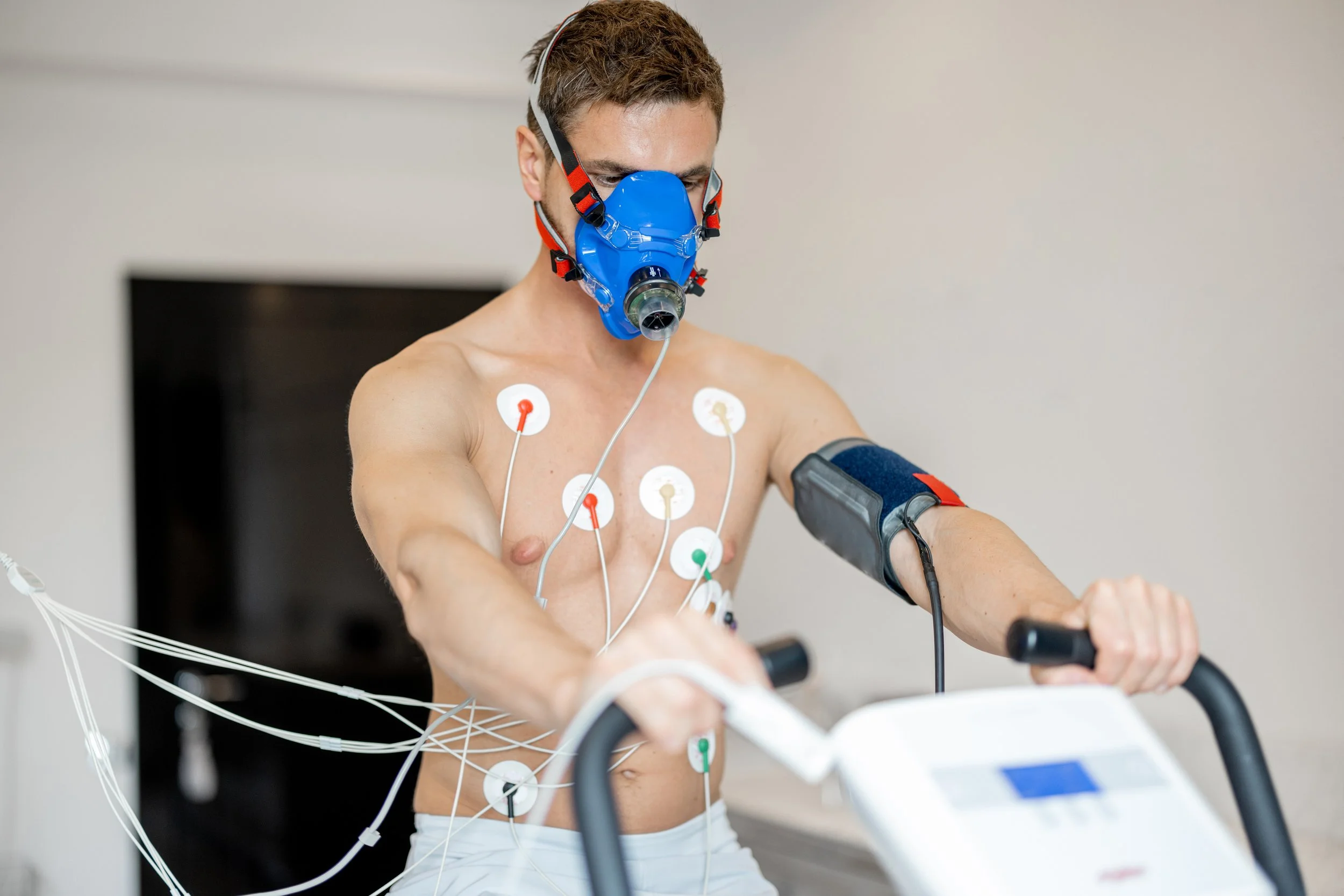
    • What it is: A supervised sub-maximal cycle test to estimate aerobic capacity (VO₂) and set heart-rate zones safely (no “max effort” required).

    • Why it helps: Guides exercise intensity, tracks fitness change, supports rehab and return-to-activity decisions.

    • What it includes: Resting safety checks → controlled bike protocol → recovery → personalised zones.

    • What to expect: Light mask or nasal cannula (breathing measured), HR monitor, cycle ergometer. You can stop anytime.

    • Prep: Bring/wear comfortable shoes; avoid heavy exercise 24-hr; usual meds unless advised otherwise.

    • Report: Programme/clinician PDF in 2–3 business days (priority 24-hr).

    • Summary -Cardiopulmonary Exercise Testing (CPET) is important because it provides valuable information about the cardiovascular and pulmonary systems during exercise. Cardiopulmonary exercise testing (also known as CPET) refers to the heart and lungs, which are two essential organs that work together to provide oxygen to the body and remove carbon dioxide. This test is linked to health and longevity. It can help identify the presence and severity of various diseases or conditions. For example, heart failure, COPD, asthma, and other respiratory or cardiovascular disorders. CPET can also help determine a patient’s fitness level and develop individualised exercise programs.

    • Sub-maximal CPET is an exceptional tool for assessing the overall functionality of both heart and lungs, without being invasive. Careful assessment at lower stress testing involves the use of mild to moderate Treadmill or Exercycle use over 3 short stages. It is particularly useful in determining fitness for operations that require general anaesthesia.

    • Duration:45–60 min total (incl. briefing & recovery)

    • Setup: Bike ergometer; nasal cannula/light mask; HR monitor

    • Prep: Comfy shoes; avoid heavy exercise 24-hr; usual meds unless advised; light snack ≥2 h prior

    • Comfort: Sub-max effort; stop anytime; clinician-supervised

    • Outputs: VO₂ estimate, ventilatory response, HR zones, training prescription

    • Results: Programme/clinician PDF in 2–3 business days

    • Follow-up: Progress check at 6–8 weeks

    • Add-ons:Exercise prescription session; ECG/HRV same visit

    • Reschedule: Free if >24-hr before.

Test Info - Clinician Level
Bookings

Electrocardiogram (ECG)

Holter ECG and HRV Testing

  • An electrocardiogram (ECG) is a simple, painless test that records your heart’s electrical activity. It shows:

    • Heart rate (how fast your heart beats)

    • Heart rhythm (how regular the beats are)

    Why we do it here
    We use a resting ECG before exercise or step tests and cycle ergometer to measure exercising ECG to make sure it’s safe to proceed with an exercise program of any intensity, and to document your baseline rhythm. If anything looks unusual, we pause and refer you to your GP or cardiologist.

    What ECG can and can’t tell you

    • Can: reveal irregular rhythms (e.g., atrial fibrillation), signs that deserve a doctor’s review, and a safe starting point for your exercise plan.

    • Can’t: diagnose blocked arteries or a heart attack by itself. ECG is one piece of the overall picture - but it ca imply the need for investigation.

    What happens during an ECG
    Small sticky sensors go on your chest/arms/legs. You lie still for 1–2 minutes while the recording is made. No needles. No exercise required, necessarily. However we also recommend a sub-maximal test can be useful to check all is well.

    What is HRV?
    Heart Rate Variability (HRV) is the tiny, natural variation in time between heartbeats. Rather than “perfectly regular,” a healthy heart speeds up and slows down slightly from one beat to the next. HRV reflects the balance between your body’s “go” system (stress/effort) and “rest” system (recovery). It helps show the balance of accelerating and decelerating tendencies of the heart. If they are out of kilter to a substantial degree this can lead to chronic cardiac conditions but more importantly it may be symptomatic of masked influence on other organs in your body.

    Why we measure HRV here
    A short 2–3 minute seated HRV reading helps us understand how recovered you are today and how your body responds to gentle effort. But also we do a 24-hr monitor using equipment that is clinical grade not consumer quality that often is found on watches for example. We use it to tailor exercise intensity and to compare your follow-up visit to your baseline.

    What HRV can and can’t tell you

    • Can: indicate current stress/recovery balance; help fine-tune your training zones and pacing.

    • Can’t: diagnose a heart condition or predict individual risk on its own. HRV is supportive information, not a diagnosis.

    What happens during HRV
    You sit quietly breathing normally while we record your heartbeat for 2–3 minutes (chest strap or ECG leads). Then we continue with the rest of your assessment.

    Preparation

    • Wear a top that allows easy placement of chest sensors.

    • Avoid heavy caffeine right beforehand if possible.

    • Tell us if you have skin sensitivities to adhesives.

    Safety & follow-up
    If we see a rhythm that needs medical review, we’ll pause testing and help you contact your GP/cardiologist. Your full report is sent within 2–3 business days (priority 24-hr if needed).

  • ECG — resting (5–10 min), holter monitoring 1-7 days.

    Body (paste as plain text)

    • What it is: A quick, painless recording of your heart’s electrical activity at rest.

    • What it shows: Heart rate and heart rhythm (e.g., can reveal irregular rhythms).

    • What Holter shows: continuous ECG to catch intermittent arrhythmias and correlate with symptoms (palpitations, dizziness).

    • Why we do it here: Safety check before exercise/step tests and a baseline for your report.

    • What to expect: Small sticky sensors on chest/arms/legs; lie still for 1–2 minutes. No needles.

    • Prep: Wear a top that allows easy sensor placement; avoid heavy caffeine right beforehand.

    • Comfort: you can shower with brief removal if instructed; but our new device is shower proof. But we’ll show you how to refit the leads.

    • Privacy: data are stored securely; only your clinical team sees your report.

    • Report: PDF in 2–3 business days (priority 24- hr).

    • HRV — exercising (2–10 mins) or 24hr holter with Sleep Apnea testing.

      Body (paste as plain text)

      • What it is:Heart Rate Variability (HRV) = tiny, natural time-differences between beats.

      • What it shows: Balance between your “go” (stress/effort) and “rest” (recovery) systems today.

      • Why we do it here: Helps tailor exercise intensity and compare your follow-up to baseline.

      • What to expect: Sit quietly breathing normally for 2–3 minutes (chest strap or ECG leads) then an exercise test will compare values to resting.

      • What it doesn’t do: HRV doesn’t diagnose a heart condition by itself—used alongside other tests.

      • Prep: Arrive a few minutes early to settle; avoid heavy caffeine right beforehand.

      • Report: PDF in 2–3 business days (priority 24-hr).

Test Info - Clinician Level
Bookings
Exercise Prescription

Exercise Prescription & Rehabilitation

    • What it is: We turn your test results into a safe, personalised exercise plan—using exercise as medicine.

    • What it’s based on: Your 6-minute walk / Chester step, HRV (2–3 min), BP/AIx, gait/strength/ROM, and goals.

    • What you get: A clear FITT plan (Frequency, Intensity, Time, Type) with heart-rate zones, strength sets, balance work, and recovery guidance.

    • Why it helps: Aerobic training supports heart, lung and vascular health; strength work preserves muscle, improves balance, and reduces falls risk.

    • What to expect: Brief review of health & meds → agree goals → build your plan together.

    • Prep: Wear comfortable clothing; bring your medications list and any home BP/device data. Take usual meds unless your doctor advises otherwise.

    • Delivery: Programme PDF emailed within 1 business day (summary for your clinician included).

    • Exercise prescription aims to use exercise as medicine.

    Prescription of specific exercise programs are those recommended by the American College of Sports Medicine - medically proven to assist with health and wellbeing.

    • Review progress, adjust zones/loads, update goals, and address any issues.

    • Recommended 4–8 weeks after your initial programme.

Test Info - Clinician Level
Bookings
Gait Analysis

Gait, Balance & Functional Agility

    • What it is: An electronically sensored walkway and balance tests to measure speed, cadence, stride length, symmetry, variability, and stability.

    • Why it helps: Identifies falls risk and mobility limits; turns results into simple balance & walking drills.

    • What to expect: A few short walks at your usual pace; optional timed balance tasks. No needles.

    • Prep: Wear comfortable walking shoes; bring your usual aid if you use one.

    • Report: Clinician PDF in 2–3 business days (priority 24-hr).

    • Detail of Use: Gait, balance and agility are important measures relating to three areas of physiology. Pain, falls and functional rehabilitation. When physical pain occurs during walking it is useful to identify the parts of walking pattern that provide discomfort. The data can be electronically measured and shared with Surgeons, Physios and Podiatrists.

    Physiological measurement of gait/balance and agility provides predictability of falls likelihood. With up to 45% of elderly people in the community falling annually (Delbaere et al., 2010), we can try and intervene and create preventative exercise.

    A gait test can prevent the associated fragility fractures, loss of independence and quality of life, and premature mortality. Functional gait analysis can help identify weakness in walking pattern due to bone, foot or muscle weakness issues. It assists in creating specific exercise prescription to prevent loss of function and for rehabilitation post incident or surgery. Thirdly the tests can provide feedback on progression and rehabilitation.

    • Duration:45 min

      • Setup: Instrumented walkway + simple balance tasks

      • Prep: Walking shoes; bring usual aid (cane/frame) if used

      • Comfort: Multiple short walks at usual pace; rests provided

      • Outputs: Speed, cadence, stride length, variability, symmetry, stability index

      • Results: PDF in 2–3 business days

      • Follow-up: Re-test in 6–8 weeks or after physio block

      • Add-ons:Strength & ROM profiling; Exercise prescription

      • Reschedule: Free if >24-hr before

Bookings
Frailty Testing

Range of Motion and Strength

    • What it is: Objective tests of muscle strength and joint flexibility to see how your body moves today.

    • Why it helps: Pinpoints weak links and stiffness that affect walking, stairs, lifting and balance; guides a targeted programme (and reduces falls risk).

    • What we test: Key muscle groups (e.g., quads, glutes, calves, grip) and joint ROM (hips, knees, ankles, shoulders) using standardised positions and cues.

    • What to expect: Short sets against resistance and simple flexibility moves; rests provided; no needles.

    • Prep: Wear clothing you can move in; bring your usual walking aid if you use one.

    • Report: Clinician PDF in 2–3 business days (priority 24 h).

    • Detail: Early identification of physical decline and appropriate interventions could help to prevent functional impairments, such as in walking and stair climbing, that often result in falls and physical frailty. (Alliance for Aging Research, 1999).

    • Duration:30–45 min (depends on number of joints/muscle groups)

      • Setup: Standardised manual/dynamometer strength tests; goniometer/functional ROM measures

      • Comfort: RPE-guided effort; stop anytime; rests between sets

      • Outputs: Peak force/hand-grip; side-to-side symmetry; ROM degrees; simple traffic-light flags

      • Follow-up: Re-test in 6–8 weeks to confirm progress

      • Add-ons:Gait & balance for falls risk; Exercise prescription to convert findings into a plan

      • Reschedule: Free if >24-hr before

Test Info - Clinician Level
Bookings

Spirometry and Walk Testing

Spirometry

    • What it is: Measures how much air you can blow out and how fast (FVC, FEV₁), with coaching for best effort.

    • Why it helps: Clarifies breathlessness, tracks recovery, and informs exercise pacing and safety.

    • What to expect: Several strong exhalations through a mouthpiece with a nose clip; we rest between tries.

    • Prep: Avoid heavy exercise 2–3 h; follow your clinician’s advice on inhalers that day; tell us if you’ve had recent chest infection.

    • Report: Clinician PDF in 2–3 business days (priority 24-hr).

    • Our equipment is the latest that has adherence to the latest international guidelines including ATS Interpretation 2021, ATS Spirometry 2019, ATS DLCO 2017.

    We also offer standardised 6MWT, Endurance-Shuttle Walk Tests (E-SWT), Intermittent SWT. Using plethysmographic pulse oximetry we are able to create perfusion Indexes for each SpO2 value.

    • Duration: 20–30 min

    • Setup: Mouthpiece + nose clip; coached exhalations; rests between attempts

    • Prep: Avoid heavy exercise 2–3 h; inhalers per clinician advice; defer if acute chest infection

    • Comfort: Brief effortful blows; no needles

    • Outputs:FVC, FEV₁, FEV₁/FVC; post-bronchodilator (if clinically arranged)

    • Results: PDF in 2–3 business days

    • Follow-up: Repeat after rehab block or symptom change

    • Add-ons:Exercise prescription; HRV same visit

    • Reschedule: Free if >24-hr before.

Test Info - Clinician Level
Bookings

Biomarkers

Coming Soon |

  • Coming Soon

  • To be confirmed.

Test Info - Clinician Level

Future health is here, it’s personalised

Learn more