

Breath Training (IMST) for Blood Pressure
Inspiratory muscle strength training (IMST) is a time-efficient, drug-free way to lower blood pressure: about 5 minutes a day of high-resistance breathing on a home POWERbreathe trainer, set and monitored from a POWERbreathe K5 baseline.
Simple breath training can become part of your normal exercise training or health routine
Thirty breaths a day, with a measurable fall in blood pressure
-
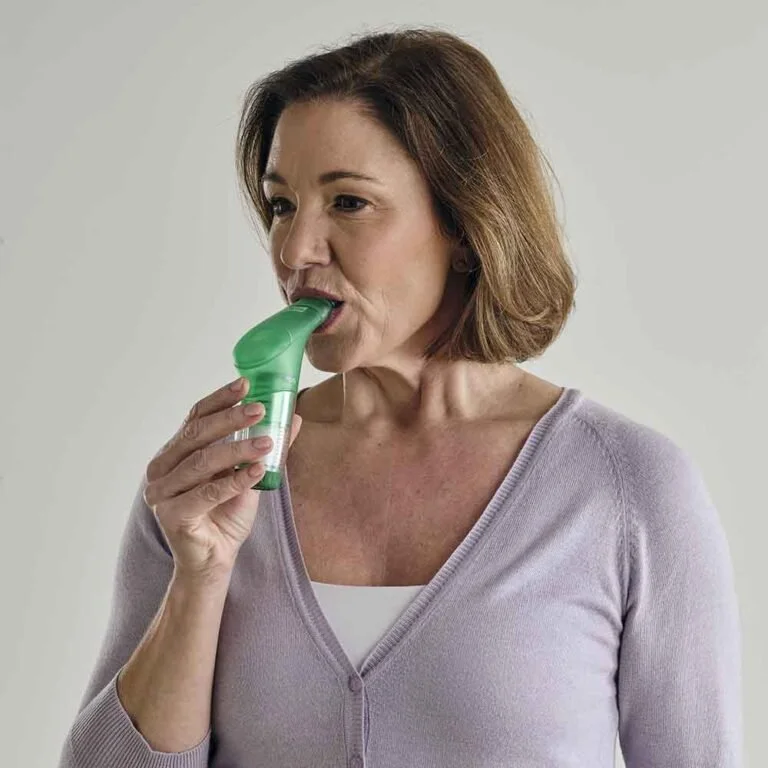
High-resistance inspiratory training at 75% of maximal inspiratory strength, 30 breaths a day, 6 days a week, set from a POWERbreathe K5 baseline.
In a sham-controlled RCT in adults aged 50-79 with above-normal SBP, casual SBP fell by about 9 mmHg and brachial FMD rose by about 45% (Craighead et al. 2021).
-
Baseline: spirometry, FeNO (Vivatmo) to screen for airway inflammation, and POWERbreathe K5 S-Index with peak inspiratory flow.
Home training on a POWERbreathe Plus or Medic Plus: 5 sets of 6 breaths, 2-week build-up (55%, then 65%) to 75% of S-Index.
Supervised first session; seated BP before and after supervised sessions; K5 re-test to reset load at review (weekly in the 6-week programme, or at 3 months).
Why Breathing Muscle Training Lowers Blood Pressure?
Short bouts of high-resistance breathing appear to improve the function of the artery lining (endothelium). In the main sham-controlled trial, training raised nitric oxide availability and lowered oxidative stress, so the arteries could relax more easily [1].
Pooled trials show falls of about 8 mmHg systolic and 4 mmHg diastolic, and the training is well tolerated [2, 3]. It may also blunt the stress-linked surges in sympathetic nerve activity that drive blood pressure up in some people.
The same trainers are used by athletes to build breathing strength and endurance [4], so IMST fits well alongside walking, swimming or cycling.
-
Raised or resistant blood pressure, on or off medicines.
People who want a drug-free option, or who cannot tolerate some blood pressure medicines.
Stress-linked or labile blood pressure on 24-hour ambulatory monitoring.
Low inspiratory muscle strength on K5 testing, or reduced exercise tolerance.
-
Drug-free and within the patient's own control.
About 5 minutes a day at home, 6 days a week.
No effect on potassium, kidney function or other medicines.
A mechanical trainer with no electronics, so no pacemaker interaction.
Objective tracking: K5 strength results and blood pressure trends show whether it is working.
-
Breathing: K5 S-Index (dynamic inspiratory strength) and peak inspiratory flow, with spirometry and FeNO at baseline.
Blood pressure: seated BP at each visit, home or cuffless BP trends, and repeat 24-hour ambulatory monitoring where indicated.
Delivery: a summary to the referring clinician at the end of the programme or at the 3-month review.
-
Manufacturer contraindications: marked elevation of left ventricular end-diastolic volume and pressure, and heart failure symptoms that worsen after training. A recent echo helps answer the first.
Precautions: previous spontaneous pneumothorax, pulmonary hypertension, ruptured eardrum or other ear conditions, and unstable asthma. Resting BP of 180/110 mmHg or higher is reviewed with the referrer and training is supervised.
Strength measure: the K5 S-Index is a dynamic inspiratory pressure measured from residual volume. It tracks static maximal inspiratory pressure (MIP) but is not interchangeable with it, so the training load is always set from the same K5 test [5].
-
Spirometry screens for unrecognised airflow limitation or restriction before high-resistance breathing is prescribed, and gives a baseline for later review.
FeNO (exhaled nitric oxide, Vivatmo) flags type 2 airway inflammation. Untreated airway inflammation may blunt the training effect, so it is managed with the GP first.
Testing follows the ATS/ERS spirometry standards and ERS guidance on respiratory muscle testing [5].
-
IMST can run alongside 24-hour ambulatory BP, pulse wave analysis, heart rate variability and tilt testing at Med-Ex.
The training week and load are recorded at each test, so changes in blood pressure, arterial stiffness and autonomic balance can be read against the training.
Repeat ambulatory monitoring at the end of a programme gives the clearest picture of the blood pressure response.
-
Craighead DH, Heinbockel TC, Freeberg KA, et al. Time-efficient inspiratory muscle strength training lowers blood pressure and improves endothelial function, NO bioavailability, and oxidative stress in midlife/older adults with above-normal blood pressure. J Am Heart Assoc. 2021;10:e020980.
A hypotensive protocol of inspiratory muscle strength training: systematic review and meta-analysis with trial sequential analysis. J Clin Hypertens. 2023.
Zheng S, et al. Effects of inspiratory muscle training in patients with hypertension: a meta-analysis. Front Cardiovasc Med. 2023;10:1113509.
Illi SK, Held U, Frank I, Spengler CM. Effect of respiratory muscle training on exercise performance in healthy individuals: a systematic review and meta-analysis. Sports Med. 2012;42:707-724.
Laveneziana P, Albuquerque A, Aliverti A, et al. ERS statement on respiratory muscle testing at rest and during exercise. Eur Respir J. 2019;53:1801214.